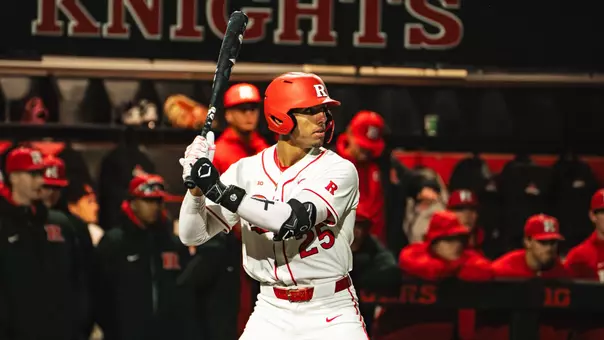
The Road to Omaha
Aug 31 | Baseball
Ron Bainton's friends in Bellevue, Nebraska, used to tease him about his football signed by Rutgers Coach Greg Schiano and inscribed Rutgers' #1 Football Fan in Nebraska. 'It should have said Rutgers' only football fan in Nebraska, they would say,' recalls the 1962 graduate of Rutgers College.
But things have changed some since last year's Insight Bowl appearance. The Scarlet Knights' gridiron glory prompted Bainton's Midwestern friends and neighbors to begin asking about Rutgers'not its football program but its academic standing. 'Now people are considering sending their kids there,' he says.
'That never would have happened without the university getting the exposure that came through the athletic program.'
Now, if he and his wife, Pat, have their way, Rutgers is going to become even more well known outside of New Jersey, particularly in Omaha, which is home to the College Baseball World Series. This past January, the couple gave $1.25 million to Rutgers baseball. Their gift, which is the single largest one-time cash gift by a living donor to Rutgers Athletics, will be used to purchase and install FieldTurf, a synthetic surface used in professional and collegiate baseball and football stadiums across the country. The new field will be known as Bainton Field in their honor. It will provide the foundation for continued enhancements to the Frederick E. Gruninger and Class of 1953 Baseball/Softball Complex.
'Because of Ron and Pat's generous donation,we'll have one of the finest fields in the Big East,' says Head Baseball Coach Fred Hill, 'and it will enable us to stay competitive.'
Currently, inclement weather can render the existing natural grass field unusable, particularly from January through March. 'The FieldTurf will allow for use of the baseball field during those winter months, giving the team an opportunity to train outdoors before embarking on a schedule that includes many early season games with schools in the south,' explains Jason Kroll, senior associate athletic director for development and marketing. 'More times than not,we have been relegated to practicing on the gravel of a parking lot, or worse, inside on the floor of the RAC. The first time we step onto an actual baseball field each year is usually the day of our first regular season game. Having FieldTurf will change all of that.'
'Over the years, Rutgers has been a darn good team,' adds Bainton. 'Coach Hill is one of the top coaches in the country and the student-athletes have phenomenal dedication. What Pat and I are trying to do with this gift is give them the opportunity to get to the highest level of Division I baseball.'
The FieldTurf will also make postponement or cancellation of games scheduled at Rutgers much less likely due to an enhanced draining system and ability to dry faster than natural grass, Kroll notes. Consequently, fewer adjustments to the schedule means there will be less of a strain upon the student-athletes missing classroom time. The donors are also convinced that a better facility will help to keep New Jersey players in state while attracting others from out of state.
'You know the movie Field of Dreams,' Bainton says. 'If we build it, they will come. I really believe that.' A baseball lover since childhood, Bainton remembers day trips into New York City from his home in Ridgewood to see major league games. After he and his wife moved outside of Omaha 10 years ago, their attention turned to college ball and they became fixtures at the College Baseball World Series. Year after year, they noticed that southern teams often dominated the finals. So when the University of Nebraska began making appearances in the final eight, Bainton had to investigate. Traveling to the school's Lincoln facility, he was bowled over by their field and decided Rutgers deserved nothing less.
This spring, the Baintons visited campus and met with the Scarlet Knights to explain their intentions. After warm thank-yous and handshakes all around, the couple stayed to watch the team warm up before their game against Lafayette. As they did, players made their way over to the couple individually to have a word.
'Jim Jansen, a senior pitcher, said,'Sir, unfortunately I won't have the opportunity to play on this new field but I'm so thankful someone is doing this for Rutgers,'' Bainton recalls. 'He was talking with us so long, Coach had to come over and tell him to go warm up!'
The Baintons also found out that a number of players have suffered injuries of varying degree while practicing in the parking lot over the years when the field was unusable. Some of those injuries, such as dislocated shoulders, have been seasonending, while others have contributed to the list of nagging ailments that can cause performances to suffer over the course of a season. The team let the Baintons know that, because of their gift, future athletes will be spared the risk of training on unsuitable ground. Making a difference in the lives of students isn't new to the couple. They have long sponsored scholarships for Rutgers College students who demonstrate academic merit and financial need; each year two juniors and two seniors receive Bainton Family Scholarships.
This year, in addressing those in attendance at the annual reception where students meet the donors who have helped them, Bainton shared his own background and explained why he and his wife take such pleasure in helping students with their education.
'It gives these students the opportunity to fully take in the Rutgers experience rather than having to drop out to earn more money for tuition,' he says.
Financial hardship resonates with the philanthropist, who worked his way though school and relied on help from an older sister who never got the chance herself to attend college.
'We lived in a town where people did well economically, but my parents struggled through the Depression and the World War II years,' Bainton recalls. 'My sister was an honor roll student, but they couldn't afford to send her to college, and being a female at a time when colleges were focused on supporting ex-military with the GI Bill, she didn't get the opportunity to go.'
A middle-of-the-road student in high school, Bainton flourished at Rutgers, he believes, because of the influence of three professors: the history department's Richard McCormick and Warren Sussman, and then University President Mason Gross, who taught philosophy.
'They opened my horizons beyond what I thought possible,' he says. From there, he embarked on a 30-year career with the Air Force, retiring in 1992 as a colonel, and eventually moving into private financial consulting work. Throughout those years, Rutgers remained dear to his heart. Grateful to the school's administrative leaders and educators who have made his alma mater one of the best public research institutions in the country, Bainton is determined to do his part in stewarding this great state resource. Bainton Field, he says, is just the first step.
'After this is done, the goal is to move forward to get supporting pieces of the puzzle'practice areas, bull pens, batting cages, better dugouts, and finally a stadium effect for supporters,' he says. 'That's my view. The athletic program is important internally to the university and externally to the future of the university. Because of athletics, you won't hear anybody asking what a Rutgers is anymore.'