Far From Running on Empty
Oct 10 | Men's Cross Country, Men's Track & Field
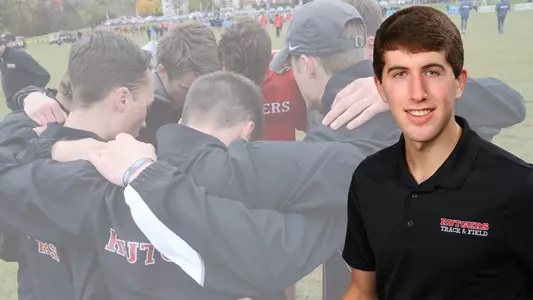
Rutgers junior Ryan Gross battles back from autoimmune disorder to race on cross country team
PISCATAWAY, N.J. (Oct. 10, 2017) – The diagnosis was Hashimoto's disease, an autoimmune condition that triggers your body to attack your thyroid gland and cause dangerously low hormone levels. Among the unpleasant symptoms are chronic fatigue, insomnia and muscle aches. The initial instinct was to run away.
A lifelong runner and standout on the Robbinsville High School boys cross country team, Ryan Gross did indeed run. He ran right at it like it was another obstacle in his way while training for a 5,000-meter championship race.
"It really gave me a different mindset as to why I'm doing this in the first place," said Gross, now a junior on the Rutgers men's cross country team. "For a while, I was always stressing and trying to make running my ticket into college. But, through this process and through the rest of high school cross country, it taught me to just experience running for the reason I got into it, that I love running, rather than needing a purpose for it."
Amid his senior season at Robbinsville with an eye on college cross country recruitment, Gross began running slower and slower, feeling more and more sluggish during every run. He was a captain and the team's top runner, so the physical limitations brought an added mental anguish of letting his teammates down. The doctors ran the gamut of tests and eventually discovered Hashimoto's disease, which had been wreaking havoc on his thyroid gland, whose responsibilities include regulating core body temperature, sleep cycles and metabolic energy distribution to joints and muscles.
"That's not what you want to hear as a runner," Gross said. "There's no solution. There's no permanent medical treatment. Basically, my thyroid is in the process of burning out right now and it's really erratic as my body keeps attacking it."
He had not quit the cross country team, although he had thoughts of doing so. Gross began taking a synthetic hormone to replicate the production of a healthy thyroid gland, and with time and unwavering dedication, he worked his times down and qualified for the NJSIAA Meet of Champions in the 800-meter run during track and field season. That's where Rutgers longtime men's track and field coach, Mike Mulqueen, noticed Gross.
"He's a tremendous worker," said Mulqueen, who is in his 36th year at the helm of the Scarlet Knights. "He always had a great attitude, especially about his physical condition. It's everything you want from a cross country runner, balancing grades, training and his overall health. He wants to get better all the time and his work ethic rubs off on his teammates."
Gross had already achieved something not many are able: he was a Division I athlete running in the Big Ten. But his battle with his body was not over at the beginning of freshman year. The disease, along with added stressors of adapting to college life, sent his thyroid function and hormone levels into disarray. He faced another uphill journey to return to his full potential. But this time, he was surrounded by Knights.
Mulqueen worked on special training plans, while his new teammates had his back on the tote path and trails "On the Banks" of the Raritan River.
"Coach noticed my dedication and he sees how passionate I am about the sport and all the things I've learned," Gross said. "So, I think that's one of the reasons that he's kept me around.
"My teammates have been really supportive throughout this whole thing," he said. "Any run or any workout where I drop off, they really just encourage me; not push me at all because I'm obviously trying to push myself. But, they encourage me. They'll say, 'stop if you need to,' if I'm not feeling well that day. They're just the greatest group of guys, I couldn't imagine any other program being so supportive about this."
Talk about time management, the essence of any student-athlete at The State University of New Jersey. Gross takes it one step further. He is an Honors College student in mathematics, statistics and economics; he is an athlete with five collegiate races under his belt; and he's a master planner as all of this revolves around a regimen of hormone supplements that require him to plan his meals and training down to the very second.
Hordes of runners across the world enjoy the sport for the escape it provides. Gross wasn't running to escape, but he did enjoy the time it afforded to think and put things in perspective.
"Those contemplations of wanting to quit really made me ask myself, 'Why am I doing this?'" Gross said. "I want to be here, I love my teammates, my friends, and I can't see myself doing anything other than running and competing every day to the best of my ability."
Gross has adopted a vegetarian diet while focusing on getting enough sleep this season. His thyroid function has been stable enough for Big Ten level training, but he has still stayed true to allowing his body the rest it needs.
Whether it's the Big Ten Championships on Oct. 29 in Indiana, or pursuing a Ph.D in statistics, Gross may not have the physical stability others have on the course or the workforce, but he has solid ground under his feet, a clear head, and a team of Scarlet Knights holding him up on the toughest days.
"That's what keeps me going," Gross said, "the great guys around me. If I have to battle back again, I'll know what I have to do. Once you start feeling that you're improving each day, it's kind of addicting, honestly. That's one of the things about running, it's addicting."
Follow Rutgers Athletics on Facebook (www.facebook.com/RutgersAthletics) and Twitter (@RUAthletics) for all of the latest news and updates. For specific updates regarding Rutgers men's cross country, follow the program on Twitter (@Rutgers_MensTF). The team is also on Facebook (facebook.com/ RutgersMensTF/).
A lifelong runner and standout on the Robbinsville High School boys cross country team, Ryan Gross did indeed run. He ran right at it like it was another obstacle in his way while training for a 5,000-meter championship race.
"It really gave me a different mindset as to why I'm doing this in the first place," said Gross, now a junior on the Rutgers men's cross country team. "For a while, I was always stressing and trying to make running my ticket into college. But, through this process and through the rest of high school cross country, it taught me to just experience running for the reason I got into it, that I love running, rather than needing a purpose for it."
Amid his senior season at Robbinsville with an eye on college cross country recruitment, Gross began running slower and slower, feeling more and more sluggish during every run. He was a captain and the team's top runner, so the physical limitations brought an added mental anguish of letting his teammates down. The doctors ran the gamut of tests and eventually discovered Hashimoto's disease, which had been wreaking havoc on his thyroid gland, whose responsibilities include regulating core body temperature, sleep cycles and metabolic energy distribution to joints and muscles.
"That's not what you want to hear as a runner," Gross said. "There's no solution. There's no permanent medical treatment. Basically, my thyroid is in the process of burning out right now and it's really erratic as my body keeps attacking it."
He had not quit the cross country team, although he had thoughts of doing so. Gross began taking a synthetic hormone to replicate the production of a healthy thyroid gland, and with time and unwavering dedication, he worked his times down and qualified for the NJSIAA Meet of Champions in the 800-meter run during track and field season. That's where Rutgers longtime men's track and field coach, Mike Mulqueen, noticed Gross.
"He's a tremendous worker," said Mulqueen, who is in his 36th year at the helm of the Scarlet Knights. "He always had a great attitude, especially about his physical condition. It's everything you want from a cross country runner, balancing grades, training and his overall health. He wants to get better all the time and his work ethic rubs off on his teammates."
Gross had already achieved something not many are able: he was a Division I athlete running in the Big Ten. But his battle with his body was not over at the beginning of freshman year. The disease, along with added stressors of adapting to college life, sent his thyroid function and hormone levels into disarray. He faced another uphill journey to return to his full potential. But this time, he was surrounded by Knights.
Mulqueen worked on special training plans, while his new teammates had his back on the tote path and trails "On the Banks" of the Raritan River.
"Coach noticed my dedication and he sees how passionate I am about the sport and all the things I've learned," Gross said. "So, I think that's one of the reasons that he's kept me around.
"My teammates have been really supportive throughout this whole thing," he said. "Any run or any workout where I drop off, they really just encourage me; not push me at all because I'm obviously trying to push myself. But, they encourage me. They'll say, 'stop if you need to,' if I'm not feeling well that day. They're just the greatest group of guys, I couldn't imagine any other program being so supportive about this."
Talk about time management, the essence of any student-athlete at The State University of New Jersey. Gross takes it one step further. He is an Honors College student in mathematics, statistics and economics; he is an athlete with five collegiate races under his belt; and he's a master planner as all of this revolves around a regimen of hormone supplements that require him to plan his meals and training down to the very second.
Hordes of runners across the world enjoy the sport for the escape it provides. Gross wasn't running to escape, but he did enjoy the time it afforded to think and put things in perspective.
"Those contemplations of wanting to quit really made me ask myself, 'Why am I doing this?'" Gross said. "I want to be here, I love my teammates, my friends, and I can't see myself doing anything other than running and competing every day to the best of my ability."
Gross has adopted a vegetarian diet while focusing on getting enough sleep this season. His thyroid function has been stable enough for Big Ten level training, but he has still stayed true to allowing his body the rest it needs.
Whether it's the Big Ten Championships on Oct. 29 in Indiana, or pursuing a Ph.D in statistics, Gross may not have the physical stability others have on the course or the workforce, but he has solid ground under his feet, a clear head, and a team of Scarlet Knights holding him up on the toughest days.
"That's what keeps me going," Gross said, "the great guys around me. If I have to battle back again, I'll know what I have to do. Once you start feeling that you're improving each day, it's kind of addicting, honestly. That's one of the things about running, it's addicting."
Follow Rutgers Athletics on Facebook (www.facebook.com/RutgersAthletics) and Twitter (@RUAthletics) for all of the latest news and updates. For specific updates regarding Rutgers men's cross country, follow the program on Twitter (@Rutgers_MensTF). The team is also on Facebook (facebook.com/ RutgersMensTF/).
- RU -




Players Mentioned

/ Men's Cross Country
Distance
/ Men's Track & FieldMonday, March 02
Monday, March 02
Monday, March 02
Wednesday, December 17